Ships Happen 002

Storm
Anchors.

Two containerships, one storm, an anchor strike that went undetected for nine months — and a $160 million crude oil release off the coast of California.

Location
San Pedro Bay, CA
Asset
16-inch crude pipeline
Total cost
~$160M USD
Threat type
Dragged anchor
The scene

Two containerships,
one heavy storm.

On 25 January 2021, the containerships MSC Danit and Beijing rode out a severe storm at anchor in San Pedro Bay, off the Port of Los Angeles. Both vessels dragged their anchors during the weather event. One of them dragged across a 16-inch crude oil pipeline.
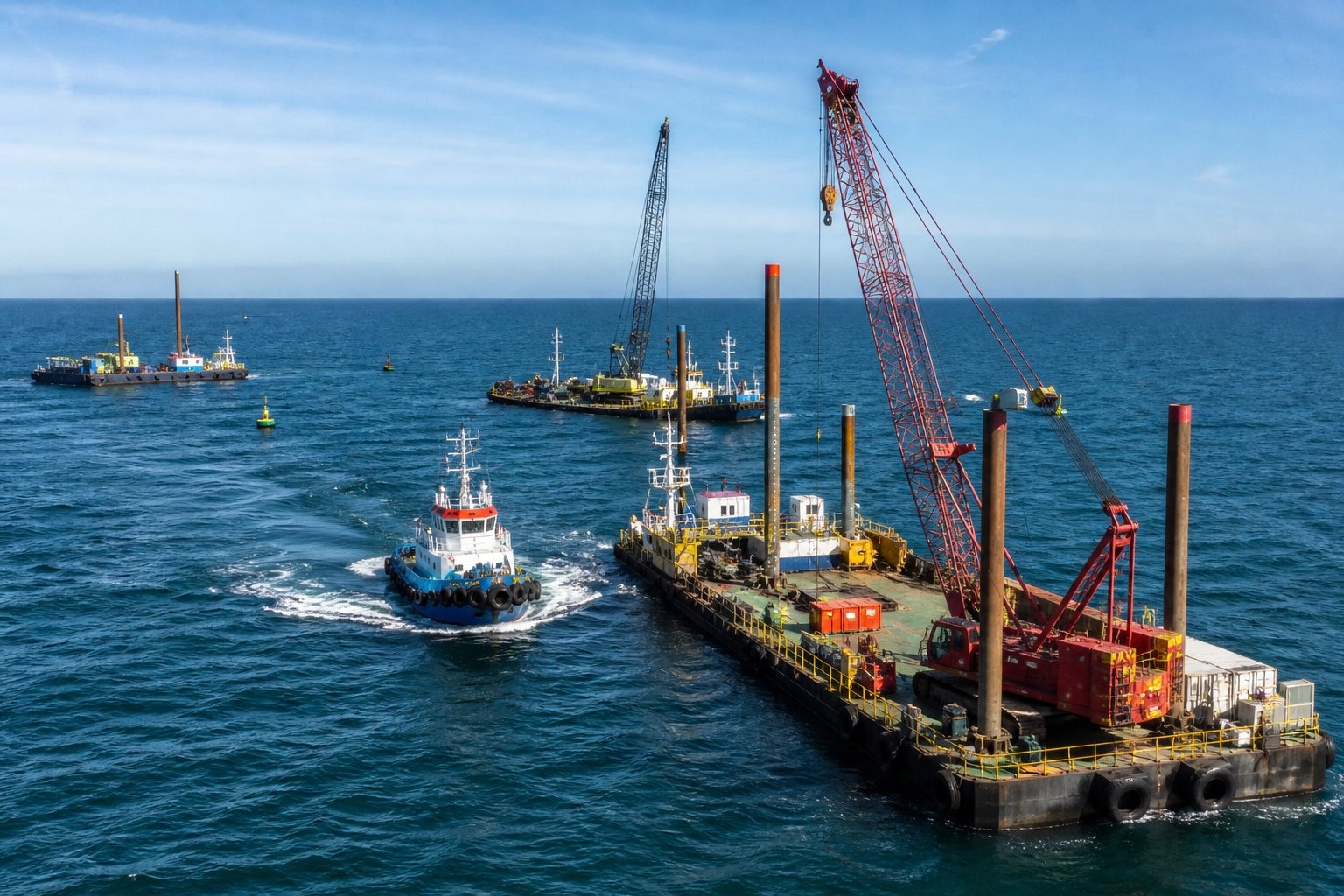
Multiple vessels at anchor and at work in a busy maritime corridor — barges, a tug, and a jack-up crane rig within meters of each other.
Crowded anchorages: every vessel above is within strike distance of every cable and pipeline beneath it.

The strike was not detected at the time. The pipeline kept operating. Nine months later, on 2 October 2021, an oil release was detected at the surface. By the time the source was confirmed, an estimated 588 barrels of crude had escaped into the Pacific.

Timeline.

25 Jan
2021
Heavy storm in San Pedro Bay. MSC Danit and Beijing both drag anchor during the weather event. MSC Danit's anchor contact is later identified as the initiating event.
Jan – Oct
2021
No damage detected. The pipeline continues operating. AIS data and seabed scars from the event sit unread for nine months.
2 Oct
2021
Oil release detected at surface. Approximately 588 barrels of crude have escaped into San Pedro Bay before the leak is confirmed.
After
NTSB overlays seabed anchor-drag scars onto the Beijing's AIS positions and concludes the Beijing's anchor likely struck the pipeline multiple times. AIS modeling of MSC Danit confirms the strike sequence.
Final
Total damages — including clean-up — estimated at ~$160 million USD. California Department of Fish and Wildlife settles violations with the vessel operators.

What the NTSB
actually found.

The NTSB investigation reads like a checklist of monitoring failures. Three findings are directly relevant to subsea pipeline protection:

01
The data existed. AIS positions for both vessels during the storm were available the entire time. Anchor-drag scars on the seabed could be matched to those positions. Nobody was running the overlay.
02
Anchorage too close to the pipeline. NTSB safety recommendations explicitly called for greater distance between anchorage locations and active subsea infrastructure — and for a notification protocol so pipeline operators learn about potential strikes in real time.
03
Vessel Traffic Service gaps. The NTSB called for improvements to VTS vessel monitoring systems. The current generation of port-area traffic services was not designed to flag anchors dragging across pipeline corridors during heavy weather.
The takeaway

The strike happened in January. The leak was detected in October. Nine months of operating data sat unread while AIS, seabed scars, and weather records had already told the story.

Why this case
matters for SEARA-SIPS.

San Pedro Bay is the textbook case for what continuous, fused subsea intelligence is supposed to prevent. The signals were all there. The fusion was missing.

Real-time AIS overlays on pipeline corridors flag anchor drag during storm events as it happens — not nine months later. Weather-driven drift modeling raises the alert threshold automatically when conditions deteriorate at active anchorages. And the same AIS-to-seabed overlay the NTSB performed forensically can run continuously, on every kilometer, against every vessel within strike distance.

The NTSB's recommendations — greater anchorage distance, operator notification, better VTS — describe a workflow. SEARA-SIPS is the workflow.

More from the series.

All cases →
001
Ships Happen 001

Donna the Dregger.

Read case →
003
Ships Happen 003

Never Too Deep.

Coming soon
Get notified

Catch the next case
before it ships.

Request a demo and we'll send each Ships Happen case study as it goes live — full timelines, data extracts, and the operational lessons.